
AI is not an Accountant
Share this post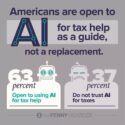
With tax season ramping up, millions of Americans are planning for the big April 15 deadline. The U.S. tax code is notoriously complex for most laypeople to grasp. Some taxpayers are turning to AI chatbots as a more cost-effective, quick way to get help with their taxes. In fact, nearly half (46%) of Americans say they trust AI for tax advice, while 21% say they’ll use AI to help them actually do their taxes this year, according to the 2026 IPX1031 Tax Procrastinators Report. Those surveyed said they planned to use AI to get answers to filing questions, find deductions or credits and proofread returns for any errors.
While plugging tax questions into an AI helper might seem like a good way to save time and money, experts warn that blindly trusting a chatbot to provide reliable tax advice could backfire spectacularly especially from a pure data-protection standpoint of putting personal information in there in an unsecured way.
The case against using AI chatbot as a tax guide
You might get ChatGPT or Claude to drum up coherent, sensible answers to pressing tax filing questions. However, as anyone who’s used the tools knows, the outputs are prone to hallucinations and inaccuracies. And the quality of the information is only as good as the prompts used to generate it, experts say.
What’s more, generative AI models use outdated training data that lag current events by months or years. For instance, OpenAI’s ChatGPT-4o (its latest model) has a training cutoff date of June 2024, while Anthropic’s Claude Opus and Sonnet’s data training is current as of August 2025. Not to mention, the IRS constantly releases bulletins and updates that may not be included in the tools’ training data.
Accuracy issues aside, the real issue when you use AI for tax help is data security and privacy. Most experts believe you should not r upload any kind of sensitive personal information into a public forum like that, because if you upload your W-2, 1099, or other tax forms, it is now public information.
Think of AI as an assistant to get generic guidance, but don’t rely on it for complex tax situations that are better left to professionals. If you feel compelled to ask your favorite AI chatbot for tax advice, take its answers with a grain of salt. Double- and triple-check the sources it provides and ask it more generic questions instead of offering up personal details that can be connected back to you experts say.
Keep in mind that as far as the IRS is concerned, you are ultimately responsible for the information you file in your tax return. If an AI chatbot leads you astray, Uncle Sam won’t be too forgiving. For assistance with your taxes, contact us we have the security and expertise you can trust.